

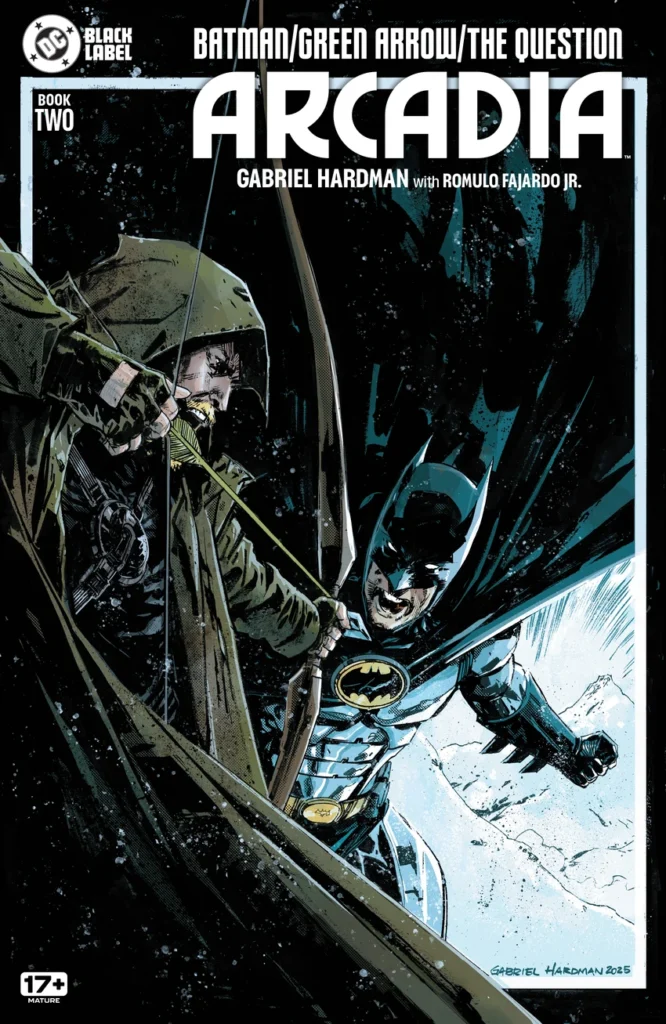
In the first issue of Batman/Green Arrow/The Question Arcadia, there was a lot more time and space for symbolism and thematic exploration. Our three main characters began in very different physical and ideological locations. By the end of the first issue, we’re all in the same physical location, the titular Arcadia, though Batman is the only one invited. With everyone all together, issue two is more straightforward and story-focused.
When we left them, The Question had worked his way to Arcadia as an anonymous migrant worker. Green Arrow opts for the direct approach and shows up to investigate. But he’s confronted by Batman, who quite presumptuously orders him to stand down. Recall that in issue one, we saw Batman stop a terrorist attack on the conference in Belize, which was enough for Arcadia project leader Emil Rotha to personally invite Batman on-site to find and stop the terrorists. So here stands Batman, working on behalf of Rotha and trying to keep the security team from killing Green Arrow.
It’s a little odd to see Batman working for the guy who’s clearly the villain of the story. He’s not quite a henchman, but the majority of the detective work and opposition to Rotha falls to Question and Green Arrow so far. Vic is making the most progress, working his way into the embedded terrorist organization on the ground. Oliver uncovers a little bit of intel through meeting Rotha, but has no interest in anything he has to offer. Coincidentally (or probably not), Rotha is the new owner of Queen Industries and is building Arcadia through it. Batman does express frustration with his situation a couple of times, but it takes a pretty significant incident to actually shift his allegiance completely.
Even though this issue is more focused on moving the story forward, the political and ideological table-setting from the first issue is still operative. Vic is in this fight to free the modern-day slaves he’s embedded with, still reciting his principles about freedom as a moral absolute. Oliver is less overt about his principles (except begrudgingly agreeing with Ronald Regan in issue one), but he’s not short on righteous indignation, especially when he confronts Rotha directly. I guess I should mention here that Rotha’s pretext for all this is climate change and rising sea levels, hence the need for floating cities free from political gridlock and government oversight. I say pretext because he’s the villain, and he’s clearly up to something else. Maybe it’s because radical environmentalists make such great villains. I wonder what Poison Ivy and Ra’s al Ghul are up to in this continuity? Anyway, Rotha’s outward justification for his project to anyone who’ll listen is the coming climate disaster, but he’s also mentioned having bigger things in mind on multiple occasions. So hopefully soon, we’ll learn what he’s really up to.
All in all, this was a good issue, even with Batman being obtuse for much of it. The artwork is good; keep an eye on the people in the background in Vic’s panels, which is exactly what he’s doing. Maybe I’m biased, but Vic is the most interesting so far, because he seems closest to breaking the case open. Perhaps that’s supposed to tell us something about where we should look and what we should care about? Still too early to say, but I’m invested. – Trey Jackson