


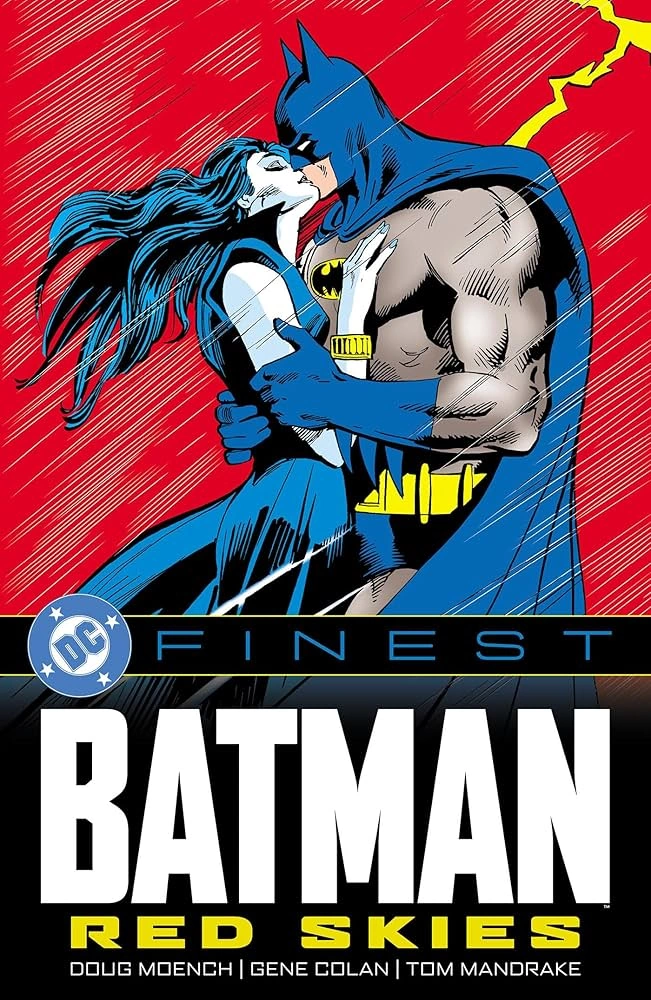
DC Comics started an ambitious new reprint line, DC Finest, a little over a year ago. And, of course, Batman figures heavily in that line. Batman sells after all, and he has a rich history. As best I can tell, the overall plan is to reprint all of DC’s comics from the beginning until the New 52 by their 100th anniversary. I doubt that will happen, but I believe Batman will come the closest to completing that goal. And that will require a steady stream of Batman reprints.
Since we have to start somewhere, I thought I’d start at the beginning of their continuous line to date, with DC FINEST: BATMAN: RED SKIES, which will lead into the already published YEAR ONE AND YEAR TWO and THE KILLING JOKE AND OTHER STORIES volumes.
RED SKIES covers books from 1985 to 1986. Issues included are BATMAN #388 to BATMAN #400, DETECTIVE COMICS #554 to #567, BATMAN ANNUAL #10, and SECRET ORIGINS #6. That’s roughly 30 issues worth of comics, not including backup stories but giving credit for larger-than-normal issues, for a suggested retail price of $40. That’s roughly $1.33 per normal-sized issue. I’d call that a bargain. Especially for stories that have been rarely, if ever, reprinted.
Of course, it’s only a bargain if the material reprinted is good. It is. Some of the best mainstream comics from the period, at least without significant involvement from Chris Claremont, Frank Miller, Walt Simonson, Alan Moore, or John Byrne. And that high quality is mostly due to Doug Moench, who writes all but two stories, with Roy Thomas handling the SECRET ORIGINS story and the legendary Harlan Ellison handling the final story in the book.
Some context, the period covers the last stages of Bronze Age Batman, from slightly before CRISIS ON INFINITE EARTHS makes an impact on the book to ending just before YEAR ONE resets Batman going forward. And, really, you don’t have to be well-versed in CRISIS ON INFINITE EARTHS to understand these issues; for the most part, all you need to know is that the skies of Gotham have turned red, the weather is behaving crazily, and there are phenomena like earthquakes occurring, and there’s a distinctive “end times” atmosphere.
A little background:
The volume begins in the aftermath of Black Mask’s debut and initial defeat. There are remnants of the False-Face society. Bruce Wayne is on the outs with erstwhile girlfriends Vicki Vale and Julia Pennyworth. But a new triangle will soon form with two dark and dangerous women re-entering Batman’s life in the form of Nocturna and Catwoman. There is a soap opera element to this era of Batman, as there’s a focus on Batman’s emotions and his loneliness, which isn’t always treated as cool, and his difficulty in forming and holding on to relationships. Catwoman becomes his partner practically, pushing aside Jason Todd’s Robin, but that relationship proves difficult to maintain.
Overall, the story reaches a climax early with Nocturna returning, and attracting Jason Todd’s Robin as a son figure, Nocturna taking control of the remnants of the False-Face society, Nocturna igniting a romantic relationship with Batman, Nocturna’s former lover the Night-Slayer carving a bloody path to get to Nocturna, Catwoman caught in the middle, and then a apocalyptic climax involving everyone. I won’t say that the rest of the book is marking time until the YEAR ONE reboot, but the Batman-Catwoman relationship is the main running plot thread, and they’re both too much adults for it to lead to earth-shattering confrontations.
That said, the rest of the book is full of solid stories. As Doug Moench was writing both BATMAN and DETECTIVE COMICS it’s one storyline that flows smoothly between titles. And with Gene Colan and Tom Mandrake as principal artists, the art is always clear but moody and atmospheric. There’s very little to complain about the art here. Although it must be acknowledged, both Colan and Mandrake are more interested in how Batman moves and the overall mood than in fight scenes. For those interested in the Comics Code Authority loosening up its standards, there is a shower scene involving Julia Pennyworth and a decapitated head cover that certainly would have raised flags not that much earlier. You can certainly see the times changing in the 1980s.
While I mentioned that you don’t really have to know CRISIS ON INFINITE EARTHS to appreciate this volume. However, you do have to be aware that this era is unfamiliar and dated in several ways. Jason Todd is the biggest one. He’s certainly not a street kid who will be caught stealing the tires off the Batmobile, but somewhat of a clone of Dick Grayson, a former circus performer who had his parents murdered. Vicki Vale surrenders to the 1980s fitness craze and starts dressing like Jane Fonda. Harvey Bullock is also a different character. He plays the slob more than he actually is, think Columbo, with his slovenly appearance hiding a sharp detective mind and a love of old movies. That love of old movies will come in handy when The Film Freak appears.
Speaking of The Film Freak, Doug Moench stays away from the classic Batman villains until the final story. For the most part. Catwoman plays a big role in the title, her biggest until Tom King comes around. Doug Moench and Denys Cowan wrap up a long-running subplot, ever since Hugo Strange discovered Batman’s identity amidst a scheme to bankrupt Bruce Wayne. (Everything old is new again.) And Two-Face gets an arc, right around the time that THE DARK KNIGHT RETURNS was being published. But, otherwise, the focus is on new villains. At least until we get to BATMAN #400. Nocturna hasn’t really been revived. Yet. But, there’s lots of enjoyment to be had in watching Batman match wits with The Film Freak. The Film Freak also refers to Marlene Dietrich’s gorilla suit musical number from BLONDE VENUS, foreshadowing BATMAN AND ROBIN. The Love Killer isn’t anyone I ever expect to return, but he brings out some unexpected vulnerabilities in Batman. Jason Todd deals with school bullies, drug pushers, and first love in the 1980s. The future team of Prey, Doug Moench and Paul Gulacy, reunite from MASTER OF KUNG FU to involve Batman in Cold War espionage, shades of TEN NIGHTS OF THE BEAST, as he attempts to stop The Dark Rider from creating a nuclear disaster.
It all culminates in an all-star jam issue as some of the best artists of the 1980s unite to tell chapters of a double-sized anniversary issue, as all of Batman’s foes are busted out of prison and he must defeat them all in one night. A precursor of KNIGHTFALL of sorts.
But wait, there’s more.
There are two issues not written by Doug Moench, and both are worthy of comment. Roy Thomas writes “The Secret Origin of the Golden Age Batman,” which fleshes out the story around “The Case of the Chemical Syndicate.” I expect that we’re all familiar with the tale. But what makes the inclusion of the issue notable is that it marks the return of Marshall Rogers, illustrating Batman interiors, and he knocks himself out, both honoring the original era and displaying Marshall Rogers’ modern-day technique, plus a ton of zip-a-tone. It’s one of the visual highlights of the book, filled with highlights.
The final is Harlan Ellison’s “The Night of Thanks, but No Thanks!” It’s billed as an offbeat tale, and that it is. It’s a night where Batman proves to be not needed. And it says something about what the character gets out of it all, and is quite frankly funny. It punctures a lot of self-seriousness about the character without turning Batman into the butt of a joke. While it will never rank among the classic Batman tales of the time, it’s a fine way to end an era.
As you can tell, it’s a large collected volume. Len Wein was the editor in charge of this era, and it feels that there is something satisfactory to read in each issue while also telling a larger story. While probably not anybody’s first choice for starting points, RED SKIES makes clear that there was life in Batman before Frank Miller.
There are some quibbles to be picked with the collection. There’s at least one panel that didn’t reproduce properly, leaving a character faceless. Word balloons repeat on one page. Those were perhaps defects of the original issues. This is not a facsimile edition, and things like backup features, ads, and letter columns aren’t reproduced. What is missing, though, is the essay Stephen King wrote for BATMAN #400, and while it’s perhaps not surprising that Stephen King’s reprint fees would be steep, it’s still disappointing that a key part of what made BATMAN #400 a celebration is missing. – Robert Reineke
GRADE: A-