


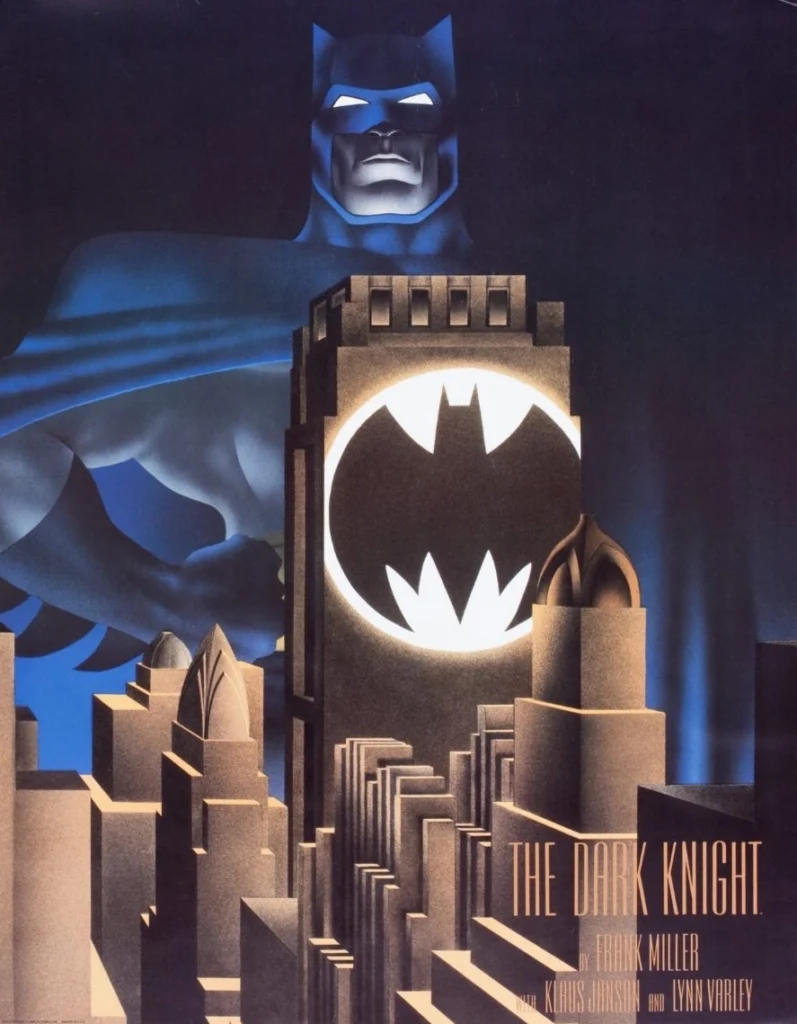
BATMAN: THE DARK KNIGHT RETURNS turns 40 this year. That’s prompted a lot of thought on my part. I’ve re-read the graphic novel. I’ve already listened to several podcasts about it. I’ve thought about it.
Like many great works, THE DARK KNIGHT RETURNS contains many ideas, and it’s not as simple to boil it down to one state. It’s deconstructionist. It’s very much of its time. It reflects thoughts on New York City of the 1970s and 1980s. It’s expressionistic. It’s political. It’s satirical. I believe it’s metatextual, with Dr. Wolper being a punching bag for Frank Miller’s thoughts on Dr. Wertham and the Comics Code Authority. It’s operatic. Frankly, I’m surprised WB hasn’t commissioned a musical. Can’t you just hear Batman singing “This isn’t a mudhole… It’s an operating table. And I’m the surgeon.” Frankly, it’s a lot of things. Many of which I believe end in -al or -ist.
That’s a preamble to say that I want to focus on the spiritual and Biblical aspects of THE DARK KNIGHT RETURNS. And I know I do so at the danger of unraveling the whole picture by pulling on one thread. There’s the old joke about three blind men describing an elephant, and most often, taking a step back and describing something holistically provides a better description. But sometimes focusing on one aspect is informative. So, don’t take this as a reading that will unlock everything that THE DARK KNIGHT RETURNS has to offer.
Let’s place THE DARK KNIGHT RETURNS in context with the rest of Frank Miller’s work at the time. And that’s mostly going to be DAREDEVIL, where Frank Miller often pitted Matt Murdock’s vigilantism against his Catholicism. ELEKTRA: ASSASSIN pitted the title character against “The Beast”, an anti-Christ-like monster. THE DARK KNIGHT RETURNS was published in proximity to DAREDEVIL: BORN AGAIN, and it’s reasonable to consider those themes part of what Frank Miller was thinking about at the time.
“The rain on my chest is a Baptism. I’m Born Again.”
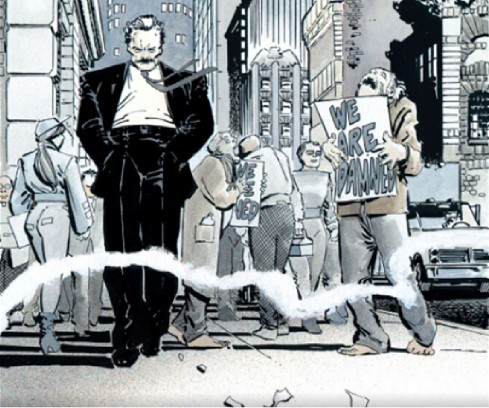
THE DARK KNIGHT RETURNS is not a religious tract, let’s make that clear right up front. It’s a superhero story informed by religious themes and symbolism, among other things. The following is intended to reveal themes and story intent, not to be anything more than an illuminating interpretation. And the religious themes and symbolism are clear from its first pages, where Bruce Wayne, lost after abandoning his crusade, is considering that all he has to look forward to is a grand death. And he wanders down the streets of a Hellish Gotham with religious placards reading “WE ARE DAMNED.” A few years later, Sam Hamm, in his BATMAN screenplay, would describe Gotham as if Hell had burst through the streets and kept going. It’s a deliberate metaphor that Frank Miller plants early.

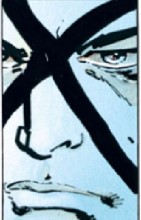
We’re introduced to a Bruce Wayne struggling with his personal demons, which Frank Miller personifies in the form of a Demon Bat. It’s not long before Bruce is confronted by that Demon Bat, and Batman returns. Intriguingly, the windows of Wayne Manor lay a cross across his face as a defense against the Demon Bat, who ultimately breaks through those windows, being denied no longer.

But, unlike a Baptism, Batman doesn’t believe that he’s prepared to seek grace. He narrates that he doesn’t have the right to say a prayer. And that sets up a major internal conflict of the series. A battle between his personal demons, or perhaps Personal Demon, and his better nature. Between what he wants to do and his rules of morality. Bruce Wayne, speaking about Harvey Dent, says, “We must believe that our private demons can be defeated.” But, it certainly doesn’t appear that way at first. At the conclusion of the first book, Batman sees Harvey Dent as a man consumed by his personal demons. A man who lost that battle, and nothing good is left of him. And Batman sees that as a reflection. At this point, the Demon is winning.
Angels and Demons
So what does the Demon Bat want? Rage, violence, chaos, and a grand death seem to be the order of the day. Sure, maybe Bruce Wayne channels that into fighting crime and protecting innocents, but that’s the deal. And we all know that deals with demons rarely work out well.
Enter a bigger demon, the Mutant Leader.
Batman narrates that he and Robin “only fought humans” when sizing up the Mutant Leader. And that’s as good a description of the Mutant Leader as there is. Most recurring Batman villains have a human dimension, but not the Mutant Leader, and that’s as good a reason as any why he hasn’t returned. We just see aspects filtered through others. The Mutant Leader is more the demon Agat from Frank Miller’s RONIN than a fully formed character. He’s rage, violence, and chaos personified with no higher purpose. And without that higher purpose, there’s no grand death promised. It’s an ugly fight that promises to end with Batman dead in a garbage heap.
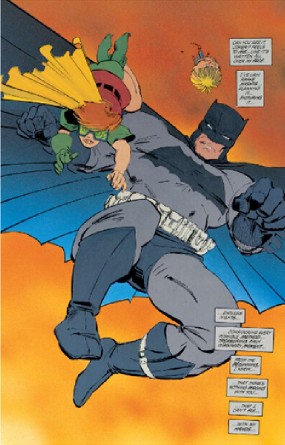
It’s up to an angel to intervene. Or maybe a ghost of a more innocent time. Regardless, Carrie Kelley saves Batman for the first but not the last time in the story at that moment. Batman is on a path that can only end in death when she arrives, but her presence leads him to a different way forward.
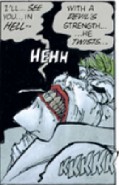
And there’s scaling from there. The Joker isn’t a demon; he’s the Devil. He pushes Batman as close as anyone to the breaking of his one rule. The temptation is almost irresistible. Just “an ounce or two more of pressure.” And the Joker’s temptation would have won and damned Batman. The Joker’s last fully formed sentence is “I’ll see you in Hell.” And then “With a Devil’s strength, he twists.” Hell and Devil are explicit word choices of Frank Miller. The fact that their final battle is underground in an underground river, the river Styx, further adds to the atmosphere of the moment.
Death and Resurrection
Killing the Joker is the last temptation of Batman. Which he successfully resists. What remains of the story is apocalypse, death, and resurrection.
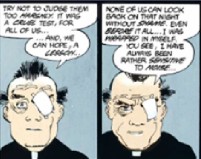
But, before Batman can create a future of order, he has one last test. As Jesus was crucified by the Romans, Batman must face the wrath of the authorities.
Much has been made of the gargoyles and eagles adorning Miller’s Gotham. It’s Hell ascended, certainly. But the eagles have also drawn comparison to Nazi imagery and fall into the accusations of fascism against the book. And I don’t think that those accusations made in good faith should be thrown out without consideration. But it’s worth remembering that before the Nazis, eagles were also symbols of the United States and of the Roman Empire.
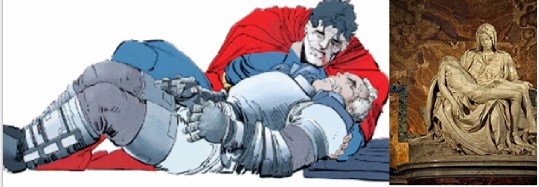
Throughout the story, the government inspires cynicism more than Patriotism. But once Batman challenges their basic authority, he’s viewed as a threat and must be taken out. That leads to the confrontation with Superman, a messiah figure corrupted by working with the authorities, and the climax of the story. I don’t think it’s a coincidence that the battle ends on a reference to Michelangelo’s Pietà.
It’s the grand death that Batman, animated by the Demon Bat, wanted. But, there’s also the resurrection of Bruce Wayne, through chemistry, not a miracle, who looks forward to a better future with his band of followers, there are twelve shown in the final page, who will bring order to a corrupt world. Everyone wins here. The Demon Bat got what it wanted with the death of Batman, but Bruce Wayne finally gets to live a good life, becoming a messianic-like leader. And Superman, with a wink, reveals that he’s not going to be the government’s lapdog and report this. Rebellion against the authorities has begun.
I’ve been thinking about Jesus Christ and comic books lately. No doubt, partly inspired by Rick Veitch finally getting to complete his Swamp Thing meets Jesus story. To be honest, I don’t think Batman and Jesus have much in common. It’s more flavorful and parallel than saying that Batman equals Jesus. Batman wears a cowl, not a crown of thorns. There’s not a crucifixion either, although Batman does kind of have the pose when his arm is broken by the Mutant Leader.
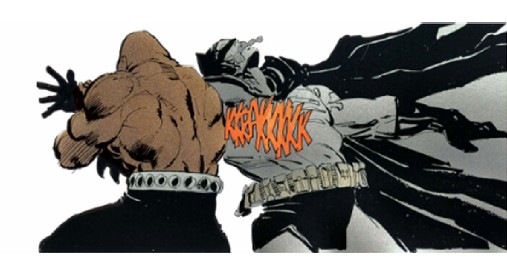
And his side is pierced.
But there’s no stigmata. We’d have to wait for Grant Morrison and ARKHAM ASYLUM: A SERIOUS HOUSE ON SERIOUS EARTH for that. For that matter, Grant Morrison picked up on the religious symbolism with that work, GOTHIC, and even the satanic aspects of Dr. Hurt in his own BATMAN run. Batman is buried and arises in that run, too.
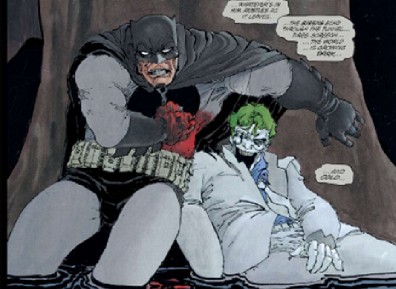
But, how much of that is deliberate, and how much of it is so much of the story of Jesus is deeply embedded in Western culture and perhaps Miller’s subconscious? I can document all the points of comparison that are actually there, but can I prove intent? Does it matter? I can probably just as easily point to Gilgamesh or Beowulf, or just save myself the bother and point to Joseph Campbell’s THE HERO WITH A THOUSAND FACES and find apt points of comparison.
I pulled out the initial plot of THE DARK KNIGHT FALLS chapter included in the tenth anniversary edition, and there’s no mention of Jesus or much that’s particularly Biblical there. Heck, there’s no mention of the crosses all over the cemetery at the funeral. Amusingly, though, Bruce does dig a “poison” capsule out of his arm, so there’s stigmata imagery. But, no, I can’t prove intent.
And frankly, I don’t see why we need Frank Miller suddenly coming out and saying, “This is what THE DARK KNIGHT RETURNS is about.” It’s big, messy, ambitious, and much discussed. It can stay that way. It doesn’t need a key to “solve” it. This is just “an approach” to reading the text. It doesn’t need to be “the approach.” The approach to reading the text is for you to read it yourself and derive your own approach. Forty years later, I’m still finding new things. – Robert Reineke