

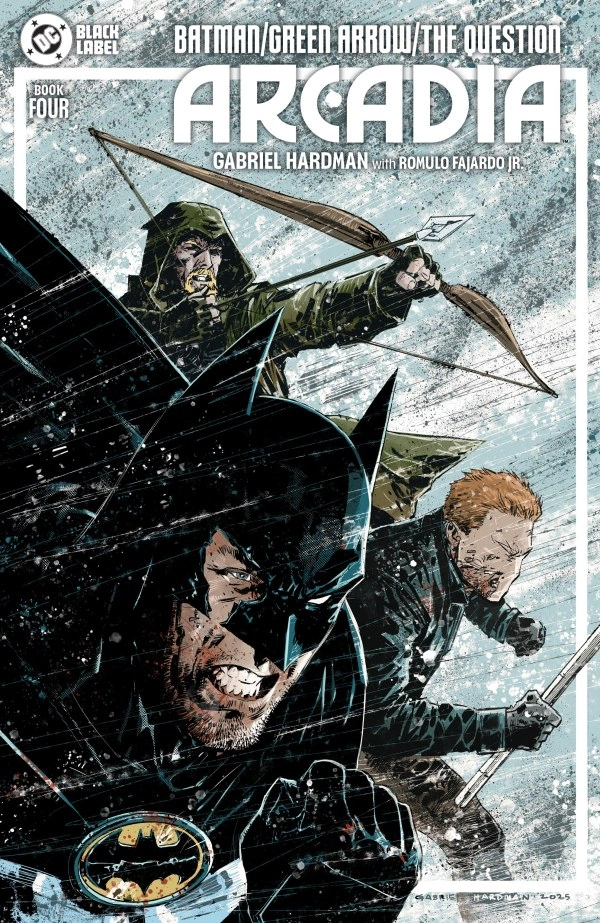
Batman/Green Arrow/The Question Arcadia wraps up with its fourth issue, released a mere four months since issue three. I don’t want to hold this against the book, because the best way to read these Black Label stories is as complete collections where inconsistent releases are a distant memory. But seriously DC, how about making sure the whole thing is finished and then releasing it monthly? Just a thought.
So how is it?
Right up front I’ll say this: I wanted to like it more. The book started out with a really interesting premise and hinted at tackling some big ideas. At the end, everything does get resolved and explained, but it just feels unsatisfying.
Think about how the book started: A mysterious villain has taken over Queen Industries and is using its resources to build a secret utopian fortress. This villain has tricked Bruce Wayne into supporting the effort by citing climate change, even though he’s using slave labor to build it. And the only lead anyone has to uncover this is The Question getting himself captured as one of the laborers. Does this sound like an interesting premise for a book? Sounds pretty cool right? It got me intrigued. Unfortunately, it doesn’t carry that momentum forward or stick the landing.
SPOILER WARNING from here on out!
The three heroes and the band of protestors start this issue in a bunker near the Arcadia project, warding off attacks from Rotha’s hired army. Thanks to Batman, the attackers can’t communicate with the mainland to call for backup, but neither can the protestors. Batman blocked communication signals when he realized Rotha knew his identity and could expose him. This point actually comes up a few times, where Green Arrow calls Bruce out for endangering them over a secret identity. Similar situations keep popping up throughout. In one panel the protestors realize they can access high ground from which to take out the attackers, but Ashti (the leader of the protestors) insists that they use the escape route to go back and free the rest of the slave laborers instead. Later they argue about how the soldiers are just paid mercenaries and how guilty mercenaries really are, underscored by one of them hiding under his desk. The symbolism doesn’t stop there though. Batman not only refuses to fire a gun, he disarms the lead soldier and knocks him out with the stock of his own rifle. And this is intercut with protestors picking up arms and giving speeches about calling the wealthy to account and Ashti shooting soldiers in the back. There’s one particular series of events that serves as the climax of the story, and to me it’s pretty clearly meant to show that killing only leads to more killing, no matter what one’s justification is. I’m curious if other readers see it the same way.
Arcadia ends with something rarely seen in a Batman story, Bruce Wayne unmasking in front of the whole world and declaring that he doesn’t have to hide his identity to fight for justice anymore. Honestly Batman giving a public speech feels more like a scene from the 66 show than a Black Label book. How did we get here? Specifically in this story, it’s because he was recorded without his mask on and decided to stop hiding his identity. But I feel like the book is trying to make a bigger point about whether good can be done anonymously or not. Bruce and Oliver think not, but it’s weird to see Batman saying that.
To close, it’s worth thinking about the character arcs for all three of our heroes:
Question: never lets up in his pursuit of the truth, even gets a protester killed in the first issue for trying to detain her and interrogate her. In this last issue he can’t even take his mask off, a notable comparison with Batman. Here is someone completely devoted to his cause. He only questions himself when he meets other protestors even more violent and committed to their cause.
Green Arrow: begins the story showing off in a bar, not interested in any kind of crusade. Pulled in with appeals to his bleeding heart and challenges to his legacy. By the end he’s laid up with a busted arm, ready to get back to leading Queen Industries. Maybe he’s already developing kryptonite-tipped arrows (sorry, wrong book, but the broken arm is there)? And he’s posed a challenge to Bruce, a challenge to fight for justice in the boardroom instead of the streets. Speaking of which…
Batman: begins the story bravely protecting a yacht from protestors’ graffiti, mildly curious about stopping global warming. After willfully playing the pawn for an issue, he teams with the protestors but still won’t let them spread their message to the world because it might reveal his identity. After he’s challenged by Oliver and his identity is potentially getting leaked anyway, he decides it’s worth letting everyone know.
Overall, this is a book worth reading, though I’m not sure it will leave the mark it hoped to. It’s asking lots of interesting questions (pun intended), but I don’t know if it doesn’t know the answers or doesn’t want to commit to saying them. Is the fight against injustice in the high rises or on the streets? How far can protests go before they’ve crossed the moral line and are no better than what they’re protesting? Why is the promise of utopia so alluring when in practice it leads to failure and violence? What makes climate activists such easy marks anyway, do they think we’re just a couple of gulags away from world peace?
Here are some questions I just can’t get over even after finishing the book:
What happened to Oliver with Queen Industries? All we’re told is that at some point he lost control of the company and his family money, with Rotha ultimately taking over. That’s happened in stories before, and maybe that’s why this one doesn’t elaborate. But whatever it was, it made an impact on Oliver that affected his arc significantly. So leaving it unexplored was puzzling.
Why is Bruce Wayne such an idiot for stretches of this book? Seriously, he’s rightfully skeptical of any utopian project’s chance at success, but letting Rotha talk Batman into being his henchman after one conversation? Rotha’s not even that interesting a villain, but how does he know Bruce is Batman anyway? We’re supposed to sympathize with him getting his identity exposed, because it happened in a moment of righteous indignation. But it could have been avoided.
The only character who kinda comes out looking OK is Question, but even he has some strained moments. He feels guilty for detaining a protestor at the scene of a crime, which led to the protester getting shot. I know issue one was eight months ago, but lest we forget, the protester was trying to destroy a transport helicopter and murder everyone on board. I get not wanting to play a part in someone’s death, but detaining a would-be murderer is usually a smart move. – Trey Jackson