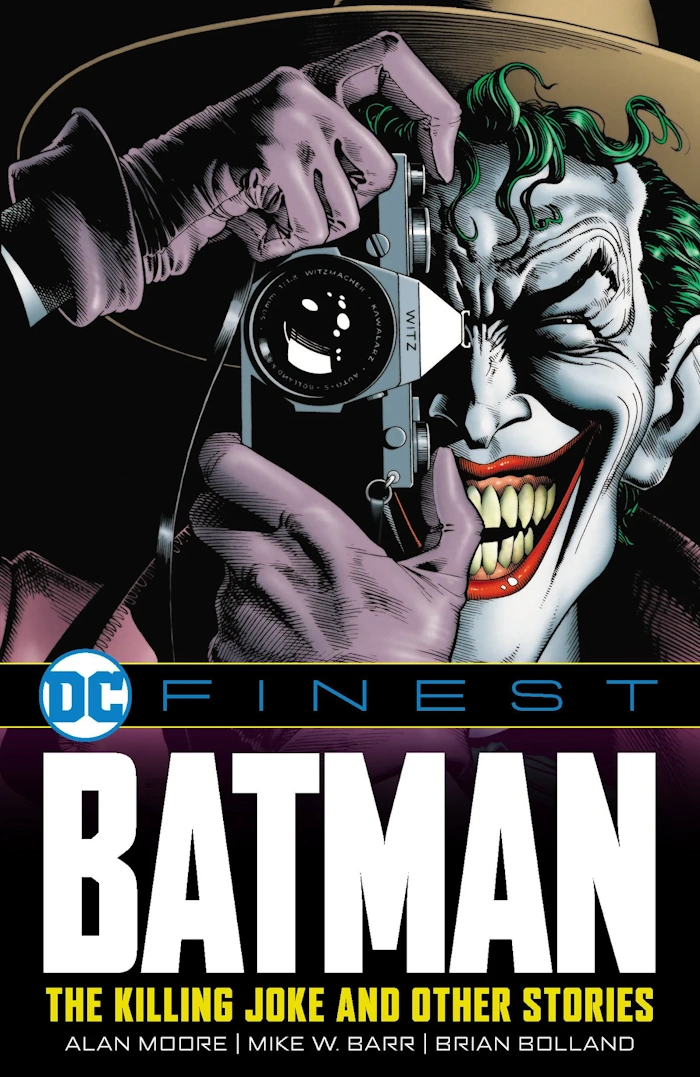
If DC FINEST: BATMAN: YEAR ONE AND YEAR TWO had a new editor, Dennis O’Neil, having a bunch of questions on how to relaunch Batman post-Crisis on Infinite Earths and post-The Dark Knight Returns, then DC FINEST: BATMAN: THE KILLING JOKE AND OTHER STORIES is when the answers become readily apparent.
Mike W. Barr and Alan Davis were talented creators, but their lighter, throwback style, despite some darker edges, wasn’t what the public wanted in the wake of The Dark Knight Returns fever. And the edgier street-punk origin for the Jason Todd Robin that Max Allan Collins cooked up never fully flowered under a revolving door of artists and a lack of clear tonal direction.
In this next volume, totaling 608 pages and 23 stories from 1987 and 1988, including the graphic novels SON OF THE DEMON and THE KILLING JOKE, you can see the answers Dennis O’Neil arrived at. Much of this material has been reprinted previously, but if you were buying these books as they were published, you would have spent roughly $33 on them. Forty years later, $40 if you don’t find a sale is less than inflation. If you’re reading this, you probably already have a copy of THE KILLING JOKE and maybe SON OF THE DEMON on a bookshelf. Maybe you even have a copy of most of these issues collected. But this is an ideal, affordable, reference collection, even if it’s not the rarest material.
As for the material itself, it includes the following:
- Material written by Mike W. Barr, including a two-part, naturally, Two-Face story in DETECTIVE COMICS #580 – 581, illustrated by Jim Balkie and SON OF THE DEMON, illustrated by Jerry Bingham.
- Stories written by Jim Starlin and primarily illustrated by Jim Aparo covering BATMAN #414 – 422.
- The beginning of the Norm Breyfogle and Alan Grant team, with John Wagner being a credited co-writer, including DETECTIVE COMICS #583 -589.
- Three single-issue and bonus stories, including a MILLENIUM crossover issue and a Poison Ivy Bonus Book. Jo Duffy writes two of the three stories. I’m glad that they’re included for completeness, but there’s nothing essential here, even if they are mostly entertaining issues. The Bonus Book is exactly that, and Jo Duffy’s stories are entertaining in their own right. That said, the MILLENIUM crossover is an interruption, while the CRISIS ON INFINITE EARTHS crossover was incorporated artfully into the overall story under Doug Moench.
- And, finally, THE KILLING JOKE by Alan Moore and Brian Bolland. The original John Higgins colors are included in this collection.
You have stories here, presented as they were published, that recreate the experience of reading Batman comics in 1987 and 1988. These books were probably a direct influence on the 1989 BATMAN film being developed, and you can see it. These books are of both historical importance and just flat-out good reads. They’d mark the quality expected for the next decade of Batman comics.
So, let’s dig in.
I’ve always liked SON OF THE DEMON since its first publication. It feels like a continuation of the Denny O’Neil / Neal Adams Ra’s al Ghul stories, coupled with more adult storytelling given license by THE DARK KNIGHT RETURNS. The fact that it’s part of mainline continuity, as shown with its inclusion here, should not be overlooked as a significant development in Batman publishing history. Mike W. Barr was capable of working in a couple of different modes, and this is more his adult, CAMELOT 3000 mode than some of his work that was purposely walking the line between serious and campy. With Jerry Bingham being illustrative and naturalistic instead of being more pop comic book, it’s a rich, high-stakes, emotional story that provides added dimension to the inner life of The Dark Knight.
Jim Starlin is most famous for his space opera comics over at Marvel. INFINITY GAUNTLET, most of all, but that would come later. But, he’d been working on the more adult DREADSTAR in the early 80s, first at Marvel’s Epic imprint and then at First Comics. It was evidently the more adult-oriented storytelling that attracted Dennis O’Neil to the veteran comics scripter. And, clearly, Jim Starlin was a fan of the work of Frank Miller. The hard-boiled adult edge that Miller brought to Batman is evident in Starlin’s work right away, along with a sympathy for crime victims and a lack of sympathy for the criminals. Starlin takes Miller;s first person narration and applies it to his version of Batman, along with an avoidance of more traditional villains as Starlin’s Batman goes up against serial killers, drug dealers, and a KGB assassin. It’s a late 1980s vision of Batman, and it works.
Joining Starlin on Batman was Jim Aparo, who was no stranger to The Caped Crusader. Aparo had drawn the odd issue in the main titles over the years, along with a slew of titles, but he’d been the main artist on THE BRAVE AND THE BOLD and BATMAN AND THE OUTSIDERS for well over a decade. Now was his chance to put his stamp on a pure Batman book, and he clearly embraced it, combining both his impeccable wordless storytelling with the bold action, now with fewer restrictions on violence than ever. Combined with an artist as writer, there wasn’t a panel wasted in this run on BATMAN. Starlin knew when to let images speak instead of words, and he never had to doubt the storytelling chops of his artist. I think it’s most evident in TEN NIGHTS OF THE BEAST, which combined the over-the-top action of an 80s movie, plenty of twists and turns, and a Miller-esque adult sensibility. And somehow it all made it past the Comics Code Authority. In the wake of THE DARK KNIGHT RETURNS, DC was touting that Comics Aren’t Just for Kids Anymore on their covers, and that clearly applied to one of their flagship characters. It was a shot of adrenaline for those of us who came of age loving the form during the period. In hindsight, I wonder if comics were even for kids anymore.
If that wasn’t enough, big things were brewing in DETECTIVE COMICS. Norm Breyfogle had evidently been wanting to put his stamp on Batman for a long time. Heck, you can go back to the 1970s and find some alternate Robin designs from him in the letter columns of BATMAN FAMILY. Breyfogle had been part of First Comics, illustrating Whisper, a kind of female ninja character, and establishing a reputation for his fluid action. Maybe not coincidentally, Breyfogle came over when there was a raid/exodus on First Comics talent, including Mike Grell, Howard Chaykin, Jim Starlin, Mike Gold, John Ostrander, Tim Truman, and Mike Baron. And right away, you saw a transition from the Adams/Aparo school to something more fluid, atmospheric, and walking an edge between cartoony and realistic. And it suited Batman well.
Joining Breyfogle were two writers who made up the British invasion of the 1980s, John Wagner and Alan Grant. Wagner and Grant had been long-running writing partners, most notable for working on the British 2000 A.D. and JUDGE DREDD in particular. (There’s been some dispute about how much John Wagner actually contributed, but I’ll default to the writing credits.) Their satiric writing fit in well with the time, and certainly they were an influence, via JUDGE DREDD, on ROBOCOP. Perhaps Dennis O’Neil was hedging his bets and needed to be won over to allow that team to tackle the existing rogues, but the result was that they had to create their own set of villains, and The Ventriloquist, The Ratcatcher, The Corrosive Man, and Mr. Kadaver were the fresh new visions. The results were two dark visions that complemented each other. One was straightforward and serious. The other was twisted and satirical. Both were not to be missed, and you could argue over which was better.
Finally, you have THE KILLING JOKE. A lot of ink has been spilled on this over the years, although everyone, from hardcore comic book fans to Tim Burton, seems to agree that Brian Bolland’s art is one of the best visual representations of Batman ever put to a page. More controversial is Alan Moore’s script and specifically the level of violence leveled at Barbara Gordon that couldn’t be set right by the final page. A final page where Batman and The Joker share a laugh while Barbara, off-page, lies paralyzed in a hospital bed. (Admittedly, while Grant Morrison’s theory on that final page is definitively not canon, I think the theory is certainly thought-provoking.) But, accidentally or not, the lack of resolution and the continuing ramifications of the story matter and define Batman’s life as one centered around unresolved trauma. And it must be said, Alan Moore can turn a phrase like few of his contemporaries. Agree or disagree with the story, it’s important to Batman History.
It may have taken a year for Dennis O’Neil’s editorialship to fully blossom, but between two old pros, a newcomer team to American comics, and two groundbreaking graphic novels, THE DARK KNIGHT RETURNS turned into a door opener, not an exception. The foundations of modern Batman in monthly comics were laid down here, and they have proven to be quite durable. This collection will help you understand the experience of witnessing it before your eyes. – Robert Reineke
GRADE: A