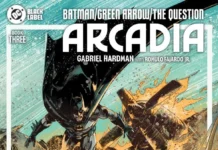

One of the great things about comics is the variety of stories that can be told. From pure entertainment escapism to serious social commentary, with everything in between. And superheroes belong in all of it. Arcadia opts for the serious route. You don’t pick ideological characters like The Question and Green Arrow without something serious in mind. This series is written and illustrated by Gabriel Hardman, who is notable for several books at DC but is also a semi-frequent collaborator with Christopher Nolan, so we’re in good hands.
For those not familiar with these two characters, here’s a brief overview: Vic Sage (The Question) is extreme in his commitment to his principles, which are that individuals and their achievements are important above all else. This is a fact about the world, and life is about honoring facts. Anything less is immoral. This is known as Objectivism, a belief system associated with right-wing conservative politics.
Oliver Queen (Green Arrow), on the other hand, began as a copy of Bruce Wayne/Batman. But later portrayals took his wealth away, so he focused more on the plight of the poor and oppressed. Now he’s more of a radical egalitarian, convinced that wealth and achievement often come with greed and abuse, so justice is about tearing down rather than building up. This is, of course, associated with left-wing progressive politics. (Side note: I’m not sure how much the left/right distinction matters anymore, because in the real world, both sides of the political aisle are adopting beliefs from all over the place. But they sure do hate each other; maybe that’s what matters.)
Anyway, these two characters and their opposing stances have been featured in stories before, memorably in Frank Miller’s The Dark Knight Strikes Again, where they debate each other on cable news. Classic Miller subtlety. Another fun fact: both owe a great deal of their lasting popularity to Denny O’Neil.
Denny did some work on another character in this issue you may have heard about: Batman. Don’t worry, he’s not ignored or overshadowed here at all. But with Question and Green Arrow representing their ends of the spectrum, Batman’s place on it isn’t as clear at the outset. But that’s by design; Bruce isn’t sure of it himself at this point. Just think about our introduction to each of these characters in this first issue:
The Question is sneaking around Hub City, obsessed with a mystery and studying a manufacturing site near his old abandoned news station. His tools are a wire cutter and a car that’s faster than it looks.
Green Arrow is the life of the party in a Star City bar, shooting through quarters and buying rounds for the house. He was removed from Queen Industries and has little else to do, heroic or otherwise, because Star City’s crime rates have plummeted, and his hometown is radically changing around him.
Between them sits Batman, who shows up to his crime scene (a vandalized yacht) in his own personal plane to catch two kids writing protest graffiti, only to let them go. Maybe he’s supposed to be the golden mean between The Question’s principles and Green Arrow’s indignation, but he’s not quite there yet.
Batman’s encounter does prompt Bruce to check out Operation Arcadia, connecting him to the mysterious manufacturing plant (and protestor) in Hub City. Turns out the manufacturing plant is off the books but owned by Queen Industries and run by a shadowy military contractor, which is enough for Vic to convince Oliver to work “together.”
Through Bruce and an invitation-only trip to Belize, we find out that Arcadia is a proposed floating city, safe from global warming and a haven for high-achieving industrial-minded (read: rich) types. Hub city’s mystery protestor gave us the initial clue, shouting “Nusquama” while bombing a transport chopper. With some help from his friend Aristotle (Tot, an incredible nickname), Vic and the reader get the first piece of the puzzle. Arcadia is meant to be a utopian city haven, though of course, there’s more to the story. If this issue didn’t have enough subtext for you, a floating utopian city should put it over the top, pun intended. Escapist utopias have long been a staple of literature. From Plato’s Republic to Thomas More’s Utopia, and notably for Vic in Ayn Rand’s Galt’s Gulch, featured on every Objectivist’s nightstand in the novel Atlas Shrugged. More recently, we’ve had literal ocean and floating cities in the Bioshock series, both critiquing utopian ideals instead of defending them. Something tells me they’ll get critiqued here, too.
If lots of symbolism and literary callbacks distract you, don’t worry, this is an engaging mystery with DC’s best detectives that should keep anyone entertained. The art complements the story well, which shouldn’t be a surprise to anyone familiar with Hardman. And if you don’t mind these extra layers, or maybe even enjoy them, there’s a lot to think too much about, which is what I feel like I’m doing in this review. But it’s fun, and if you’re still reading, you must not mind. I don’t know how much any of the subtext will end up mattering, but it’s not there by accident. So I feel like I can recommend issue 1 no matter where you’re coming from, and I’m thinking the rest of the book will deliver too. – Trey Jackson