In 1818, Mary Shelly published her novel, Frankenstein: The Modern Prometheus, known by most as Frankenstein today, and created a character archetype that has had many incarnations.
The latest is Maggie Gyllenhaal’s film The Bride!. Gyllenhaal gives us a beautiful mess of a film that leaves the viewer to piece together the narrative, much like the mad scientist made his monster from the discarded parts of other human beings. The film is a patchwork of ideas, themes, stunning visuals, and exceptional performances, but the chaotic presentation may not suit everyone.
Gyllenhaal both wrote and directed this reimagining of the famous work, so the confusion you may feel while watching it is her responsibility. There are so many themes arising from the characters and the story: humans playing God, defying societal norms, the marginalized and outcasts from society, love, death (both physical and spiritual), courage, cowardice, power and corruption, fate and its sometimes cruel outcomes, fantasy vs. reality, innocence long lost, and the search for self. And that’s just a partial list. The problem is that none of them are truly developed, leaving the audience a crazy quilt of ideas to try to form into some kind of cohesive narrative. It could have been so much better if a bit of restraint had been practiced.
To Gyllenhaal’s credit, the film is endlessly creative and interesting visually. Again, a number of cinematic techniques are borrowed from other films. There are definite echoes from both Joker films, from 1930’s gangster films, and of course, from the original films from that time period, Frankenstein and The Bride of Frankenstein. The basic characters are here, but with significant changes.
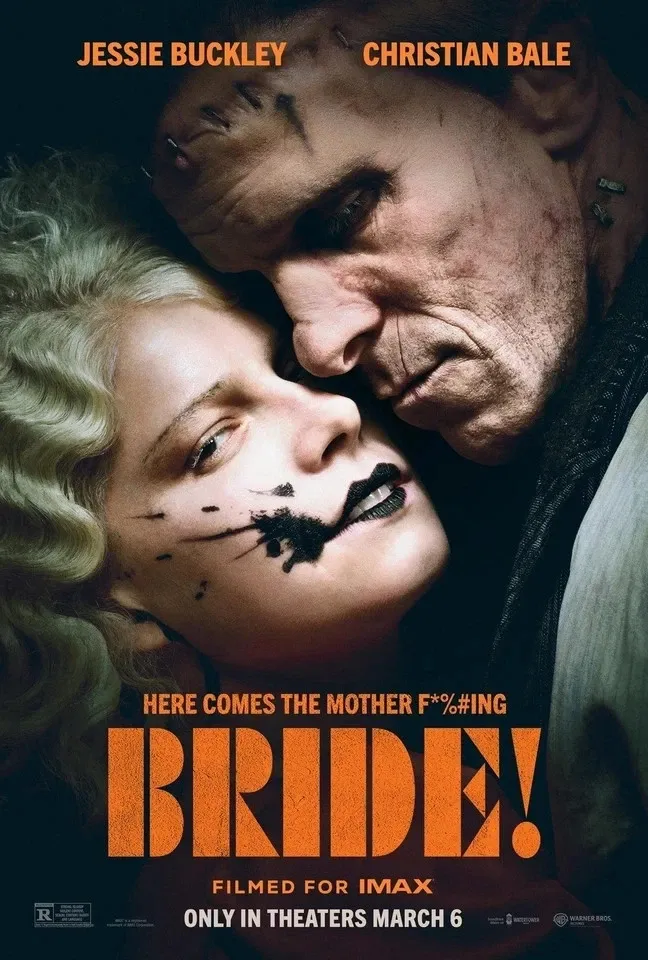
Christian Bale portrays a very polite and apologetic monster. He goes by Frank for most of the film and keeps a low profile to avoid people’s predictable reaction to his appearance. When triggered, however, he goes into a primal scream rage and wreaks havoc. Bale gave an interesting interview online about the “primal scream” and how he got everyone in the cast and crew doing it too. No real explanation is given for how he arrived in 1930’s Chicago from his origins in 19th century Europe, but he’s in town looking for love. He’s a very lonely monster. He spends his time in theaters watching musical romantic comedies starring a particular actor, Ronnie Reed, played by Jake Gyllenhaal. From these films, he gets his idea of love and romance.
There’s a mad scientist, of course, whom he believes can make him a companion. She’s Dr. Euphronicus, played by Annette Bening, known for experimenting with reinvigoration, basically bringing dead bodies back to life. Together, Frank and the doctor plan to dig up a recently deceased corpse rather than piecing together parts from various bodies.
Enter Ida, brilliantly played by Jessie Buckley, who doesn’t know that her fate will provide that body. She looks to have fallen in with the wrong crowd in a big way. While partying in a speakeasy with some rich, powerful men and some other pretty girls, she gets herself into trouble and is murdered. Previously, in a very quirky prologue, the apparent ghost of Mary Shelly in Hell is raging about getting her story and her rage out of her brain. Somehow, Ida’s brain becomes Mary’s surrogate brain, allowing Mary to speak through Ida. It’s Mary’s words that get Ida into trouble that fateful night. She says too much about what the mob boss and his pals have been doing and ends up at the bottom of a very long staircase.
When Frank and the doctor go to Potter’s Field, it’s her body they dig up. The reanimation works, but with a flaw. The dark fluid injected into her veins for the process bursts out of her mouth and stains her lips and one cheek with a distinctive black mark. The resurrected Ida has no memory of what happened or who she is. She still speaks with two voices, and Mary’s voice is an extremely angry one. It wants vengeance for all the wrongs done to women by men and all the limitations put on them by male-dominated society. It’s a feminist film, and I think it will be received differently by men and women. All the male characters are very flawed – stupid, cruel, or cowardly. The women are largely victims or eccentric recluses.
When the newly liberated Ida and the besotted Frank begin to go out on the town, they end up at the same club where Ida died. She stirs things up with wild dancing, cursing, and aggressively insulting the men. She tells the other women in the club that they don’t have to do what the men want.
When they attempt to throw her out, she grabs a cop’s gun and all hell breaks loose. Now, the Bonnie and Clyde part of the film begins. They go on the run and are tracked by a cowardly, dirty cop, Detective Jake Wiles (Peter Sarsgaard), and his secretary, a very sharp and ambitious Myrna Mallow (Penelope Cruz).
The two lovers are chased doggedly across country, eluding many attempted captures, until they end up back at Dr. Euphronicus’s house for the final scenes.
Meanwhile, women across Chicago have begun painting their faces, imitating the distinct mark on Ida’s face. An entire movement has arisen, and they would prefer not to be controlled by men. They’re locked, loaded, and ready to go. It’s an extreme reaction, but it’s an extreme film. I would have liked to see a bit of subtlety. Reactions to the film will most likely be extreme as well.
Is The Bride! worth seeing?
Jessie Buckley’s amazing performance is reason enough. You can’t take your eyes off her. Her presence is all-consuming. She owns this film. If you’re a Christian Bale fan, you’ll find his performance satisfying, although at times, I found it to be almost a parody. It’s kind of a thankless task to portray a monster as famous and ubiquitous as this one.
Ultimately, say yes, go see this beautiful mess. – Jo Anne Hyde
GRADE: B-